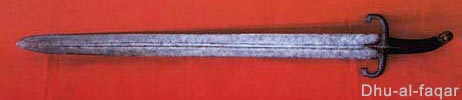
| The battle of Ditch: The Ali and the Giant | |||
|
On the advise of Hazrat Salmaan Faarsi , it was decided that a trench be dug. Since Madinah was surrounded on two sides by lava rock and palm groves on the third side it was decided to dig the trench on the open approaches. Holy Prophet with the assistance of the Muhajireen and the Ansaar got down to the difficult task of digging the trench. They made the trench 5 meters deep and 5 meters wide. All the time the Sahaba were marvellously inspired by Holy Prophet
himself who worked as a labourer amongst them. The enemy approached
Madinah and faced a setback when they saw the deep trench around
the town. They settled down to a siege. The siege went on for 27
days. They failed to penetrate the defiance of the Muslims. This huge man was of a tremendous height and bulk, and while on his feet would tower above his fellow men. Sitting on his great horse, he looked positively unreal. Big, strong and fearless, he had a fierce countenance-an aspect which thrilled his comrades and dismayed his enemies. This was Amr bin Abdu Wud. (We shall call him the Giant!) Horse and rider stood motionless as he let his gaze wander scornfully over the ranks of the Muslims. Suddenly the Giant raised his head and roared, "I am Amr bin Abdu Wud. I am the greatest warrior in Arabia. I am invincible. I... I. . ." He certainly had a high opinion of himself. "Is there anyone among you who has the courage to meet me in personal combat?" The challenge was received by the Muslims in silence. They looked at one another. They looked at the Holy Prophet. But no one moved, for the Giant was famous for his strength and skill, and though wounded several times, had never yet lost a duel, nor spared an opponent. It was said that he was equal to 500 horsemen; that he could lift a horse bodily and hurl it to the ground; that he could pick up a calf with his left hand and use it as a shield in combat; that he could... The stories were endless. The vivid Arab imagination had created around this formidable warrior a legend of invincibility. So the Muslims remained silent, and the Giant laughed with contempt-a laugh in which the Quraish also joined, for they stood quite close to the ditch and could see and hear all that went on. "So is there none among you who has the courage of a man? And what of your Islam? And your Prophet?" At this blasphemous taunt, Ali left his position in the front rank of the Muslims, approached the Holy Prophet and sought permission to engage the challenger and silence his insolent tongue once and for all. The Prophet replied, "Sit down. This is Amr!" Ali returned to his position. There was another burst of scornful laughter, more taunts, another challenge. Again Ali went up to the Prophet. Again the Prophet declined permission. More laughter, more taunts. Again the challenge from Amr, and this time more insulting than before. "Where is your paradise?" He shouted, "Of which you say that those who lose in battle will enter it? Can you not send a man to fight me?" When for the third time Ali moved towards the Prophet, the latter saw in Ali's eyes a look which he knew well; and he knew that Ali could no longer be restrained. He looked at Ali fondly, for Ali was dearer to him than any other man. He took off his turban and wound it around Ali's head. He next took off his sword and girded it at Ali's waist. And he prayed: "O Lord! Help him!" 1 This sword which the Prophet now gave to Ali had once belonged to an infidel by the name of Munabba bin Hajaj. This man had been killed at the Battle of Badr, and the sword had come to the Muslims as part of the spoils of war. The Prophet had taken the sword for himself. Now in Ali's hand this was to become the most famous sword in Islam, killing more men in fair combat than any sword in history. This was the Dhu-Al-Faqar.
Ali hastily collected a small group of Muslims and strode out towards the unbelievers. The group stopped at some distance from the Giant, and Ali stepped forward and got to within duelling distance of the challenger. The Giant knew Ali well. He had been a friend of Ali's father, Abu Talib. He now smiled indulgently at Ali as a man might smile at a boy. "O Amr!" called Ali. "It is believed that if any man of the Quraish offers you two proposals, you always accept at least one of them." "True." "Then I have two proposals to offer you. The first is: accept Allah and His Messenger and Islam." "I have no need of them." "Then dismount from your horse and fight me." "Why, O son of my brother? I have no desire to kill you." "But I", replied Ali, "Have a great desire to kill you!" 2 The Giant's face flushed with anger. With a cry of rage he sprang off his horse, displaying a degree of agility surprising in so huge a monster. He hamstrung his horse, drew his sword and rushed at Ali. The fight was on. Amr struck at Ali many times, but Ali remained unharmed. He would parry the blow with his sword or shield or nimbly step aside to let the Giant's sword whistle past him harmlessly. At last the Giant stood back, panting and baffled. He wondered how this could be. Never before had any man survived so long in personal combat against him. And now this boy was looking at him as if he was playing a game! Then things happened so fast that no one could quite follow the sequence-neither the Muslims nor the Quraish nor the Giant himself. Ali dropped his sword and shield to the ground; his body shot through the air like a missile and his hands grasped the Giant's throat; with a wrestler's kick he knocked the Giant off balance, and the Giant came crashing to the ground-all in a matter of seconds. Now the Giant lay on his back with Ali sitting astride his chest. The two armies gasped and murmured, then held their breath. The bewilderment on the Giant's face changed to fury. At last he had been thrown, and by this young upstart who was less than half his size! But although he was down, he was not finished. He would still win the battle and re?establish his position as the greatest warrior in Arabia. He would toss this youngster into the air as a leaf is tossed by the wind. The Giant's face went purple, the veins stood out
on his neck and his huge biceps and forearms trembled as he strained
to break Ali's grip. But he could not move it an inch. There was
the quality of steel in the muscles of Ali. But this was more than the Giant could take. Was he whom Arabia considered her greatest champion to live the rest of his life under the shadow of defeat and disgrace? Was it to be said of him that he saved his life in personal combat by submitting to the conditions of his opponent? No! He, Amr bin Abdu Wud, had lived by the sword. He would perish by the sword. A life spent in violence must end with violence. He gathered the spittle in his mouth and spat into the face of Ali! He knew what would happen. He knew that there would be a sharp intake of breath, that Ali's right arm would shoot into the air and then plunge the dagger into his throat. Amr was a brave man and could face death without flinching. He arched his back and raised his chin?to offer his throat to Ali, for he knew what was to come. At least he thought he knew! But what happened next left him even more bewildered. Ali rose calmly from Amr's chest, wiped his face, and stood a few paces away, gazing solemnly at his adversary. "Know, O Amr, I only kill in the way of Allah and not for any private motive. Since you spat in my face, my killing you now may be from a desire for personal vengeance. So I spare your life. Rise and return to your people!" The Giant rose. But there was no question of his returning to his people a loser. He would live a victor, or not at all. Intending to make one last attempt at victory, he picked up his sword and rushed at Ali. Perhaps he would catch Ali unawares. Ali had just enough time to pick up his sword and shield and prepare for the fresh assault. The blow which the Giant now delivered in furious desperation was the most savage blow of the encounter. His sword shattered Ali's shield, but in doing so lost its force and impetus, and could then do no more than inflict a shallow cut on Ali's temple. The wound was too slight to worry Ali. Before the Giant could raise his sword again, the Dhu-Al-Faqar flashed in the sunlight, and it's tip slashed open the Giant's throat. The blood of the Giant gushed forth like a fountain. For a moment the Giant stood motionless. Then his body began to sway as if he was drunk. And then he fell on his face with a crash and lay still. The earth did not shake with the impact of that colossal body. The earth is too big. But the hill of Sil'a shook with the cry of Allah-o-Akbar that thundered from 2,000 Muslim throats. The triumphant cry echoed through the length and breadth of the valley before it faded away into the stillness of the desert. The Muslim group now rushed at the six remaining Quraish. In the sword fighting that ensued, one more Quraish was killed and one Muslim fell. A few minutes later the Quraish group turned and hastily withdrew across the ditch. Ikrimah dropped his spear as he jumped the ditch, on which Hassaan the Poet wrote many a rude verse. A man known as Nofal bin Abdullah, a cousin of Khalid's, was not successful in clearing the ditch and fell into it. Before he could rise, the Muslims were on the bank and hurling stones at him. Nofal wailed, "O Arabs! Surely death is better than this!" Thereupon Ali obliged the man by descending into the ditch and cutting off his head. |
|||
| Source: http://www.swordofallah.com/html/bookchapter4page4.htm | |||